
Lumbar Decompression
Lumbar spinal canal decompression is one of the most common surgical procedures for spinal disorders. For more than seven years we have performed this surgery exclusively using a minimally invasive percutaneous technique, with an experience of more than 1,000 surgical cases.
The procedure is performed under general anesthesia with antibiotic prophylaxis.
To improve surgical precision and minimize the surgical exposure, the procedure is performed using navigation based on an intraoperative CT scan (O-Arm).
The incision is approximately 2 cm and is horizontal (in contrast to the incision used in the conventional technique). The incision is made on one side but allows bilateral decompression of the nerves. A single incision allows decompression of up to two levels. For decompression procedures involving three or more levels, a second 2 cm incision is performed.
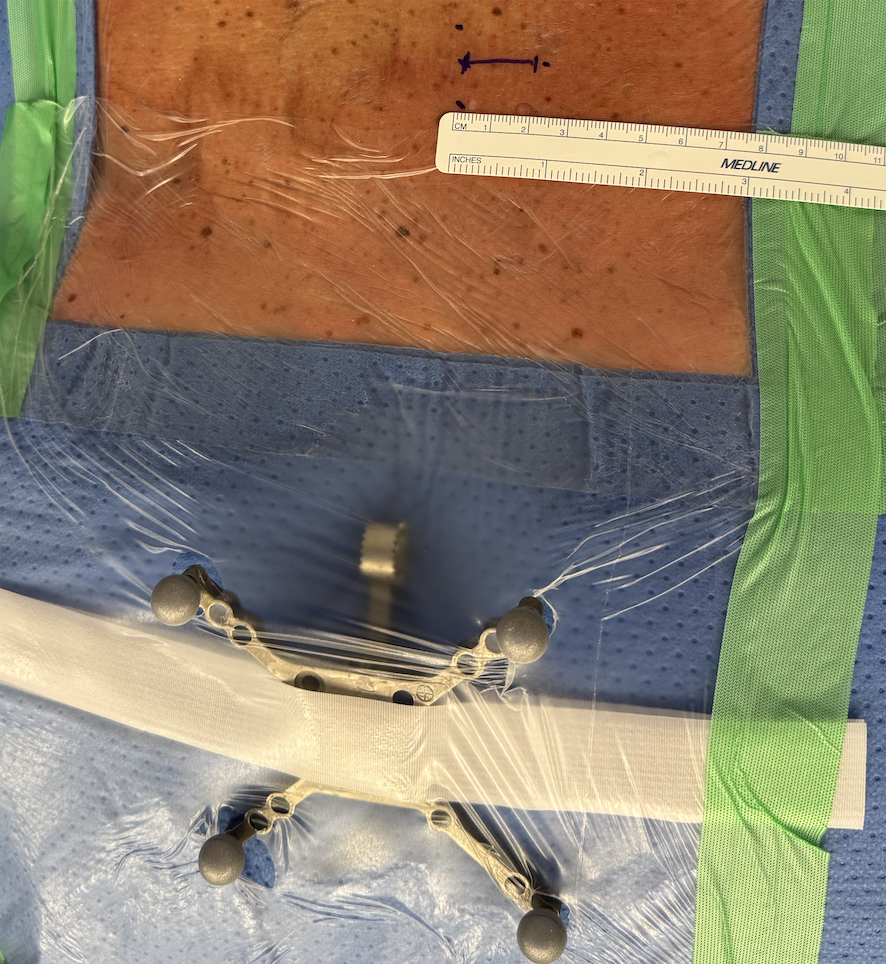
Example of incision size for a decompression on 2 levels
After opening the muscular fascia, progressively larger dilators are inserted under navigational guidance until the final tubular retractor of 16 mm diameter is placed.
Inside this tubular retractor, under microscopic visualization, the vertebral lamina is drilled and the ligamentum flavum is removed. By removing the ligamentum flavum, the arthritic component compressing the nerves is also removed. By adjusting the orientation of the tubular retractor, both sides of the spinal canal can be decompressed.
At the end of the procedure, the retractor is removed and the muscular fascia and skin are closed after careful hemostasis. The operative time is approximately 30 minutes per level.

Illustration of the tubular retractor for laminectomy
The minimally invasive technique helps reduce surgical risks and postoperative pain. However, surgical risks cannot be completely eliminated. Our personal statistics for this type of surgery are:
- Postoperative hematoma <1%
- Dural tear <1%
- Surgical site infection <0.5%
- Direct neurological injury 0%
The overall complication risk is less than 2% for this procedure.
The postoperative period generally includes:
- Hospital stay of 48 hours
- Physiotherapy starting after 2 weeks
- No stitches to remove
- Full return to activities after 1 month
If you require an evaluation for a lumbar stenosis and wish to have it performed with us, you may contact us via the online form or by email : segretariato@neurochirurgia-robert.ch