
Medullary vascular malformations
Vascular malformations of the medulla are not well-known diseases due to their rarity. Such pathologies are difficult to treat and necessitate an important experience for the physicians. They are divided in 3 pathologies:
1. Dural arterio-venous fistulas
It is defined as an abnormal connexion between a dural artery and a medullary vein. The consequence of this fistula is a venous reflux in the medullary network. The patient presents a myelopathy syndrome with progressive neurological deficits. Two types of treatment could be proposed. The microsurgical clipping and the endovascular embolization. We have an important experience in the surgical treatment of this pathology. This is a treatment we propose at Clinique La Source in Lausanne.
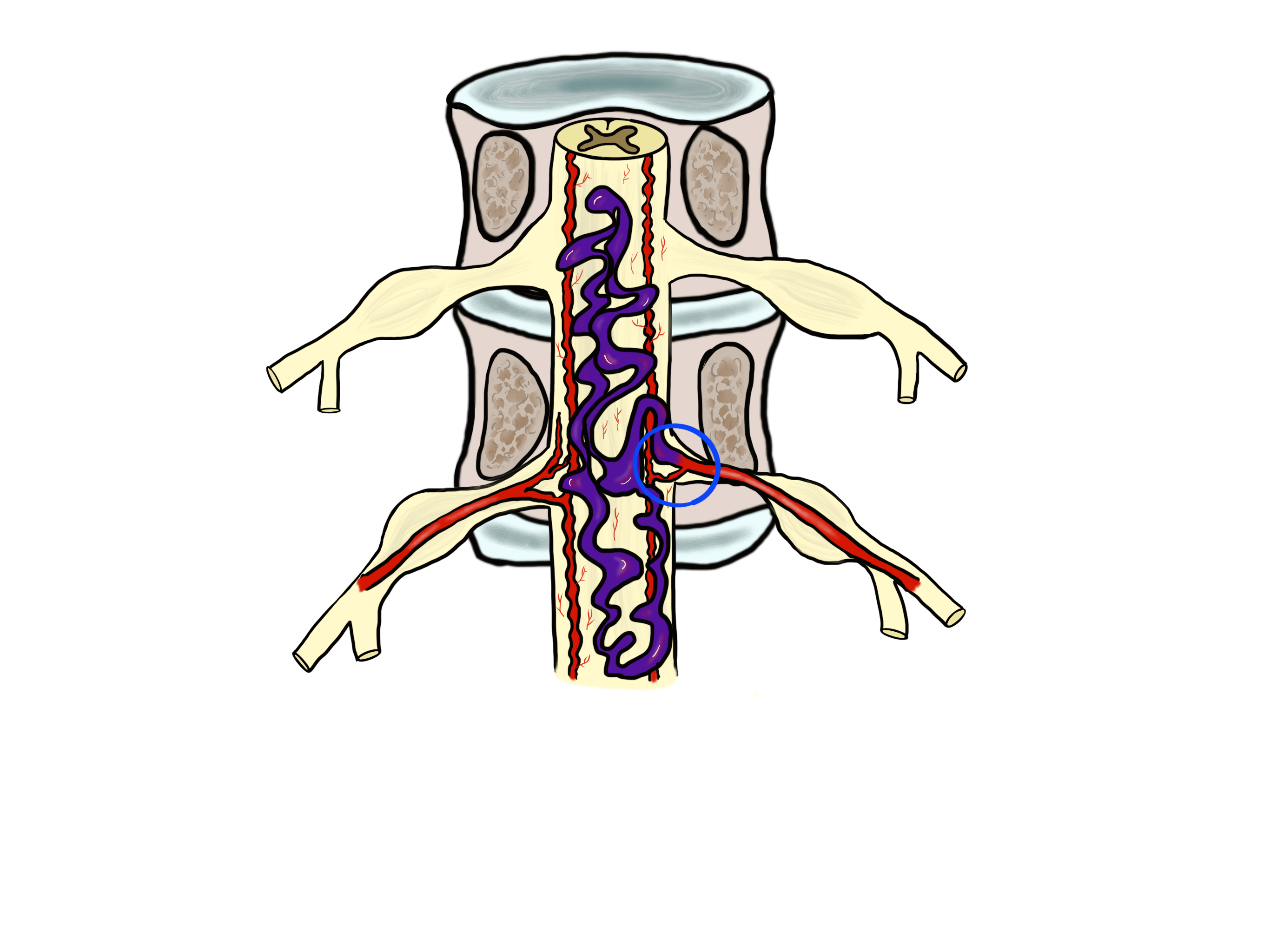
Medullary arterio-venous fistulas
2. Pial arterio-venous fistulas
They are very infrequent arterio-venous fistulas. The abnormal connexion is between a medullary artery and a medullary vein on the medulla. As the first type, it provokes a myelopathy syndrome with progressive neurological deficits. The two treatments, surgical and endovascular, are possible and the choice depends on the micro-anatomy of the fistula. We have an important experience in the surgical treatment of this pathology. This is a treatment we propose at Clinique La Source in Lausanne.

Medullary arterio-venous fistulas
3. Medullary arterio-venous malformations
They are also very rare and complex pathologies. Usually, patients present neurological signs with very slow evolution without back pain. Surgery of spinal MAV exeresis is only proposed by few neurosurgeons and risks and benefits of such surgery must be discussed in details before.