
Posterior Cervical Foraminotomy
Posterior cervical foraminotomy is a minimally invasive procedure designed to relieve compression of a cervical nerve at the level of the foramen, the small lateral opening through which the nerve exits the cervical spine and travels toward the arm.
This compression may be caused by a lateral disc herniation, cervical osteoarthritis or foraminal stenosis. When the nerve is irritated or compressed, patients may experience neck pain radiating into the arm, tingling, sensory changes or, in more advanced cases, weakness.
When is this procedure indicated?
Posterior cervical foraminotomy is mainly indicated in cases of cervical radiculopathy, meaning irritation or compression of a cervical nerve root, when the compression is located laterally and the intervertebral disc does not need to be removed completely.
In selected cases, this procedure allows the nerve to be decompressed without fusing the cervical segment and without placing any osteosynthesis material. It may therefore represent an alternative to the standard anterior approach, such as anterior cervical discectomy.
Conservative treatment
In most cases, cervical radiculopathy can initially be treated conservatively with pain medication, anti-inflammatory drugs, targeted physiotherapy or periradicular injections.
Surgery is considered when pain remains significant despite conservative treatment, when symptoms have a major impact on quality of life or when a neurological deficit is present, particularly weakness.
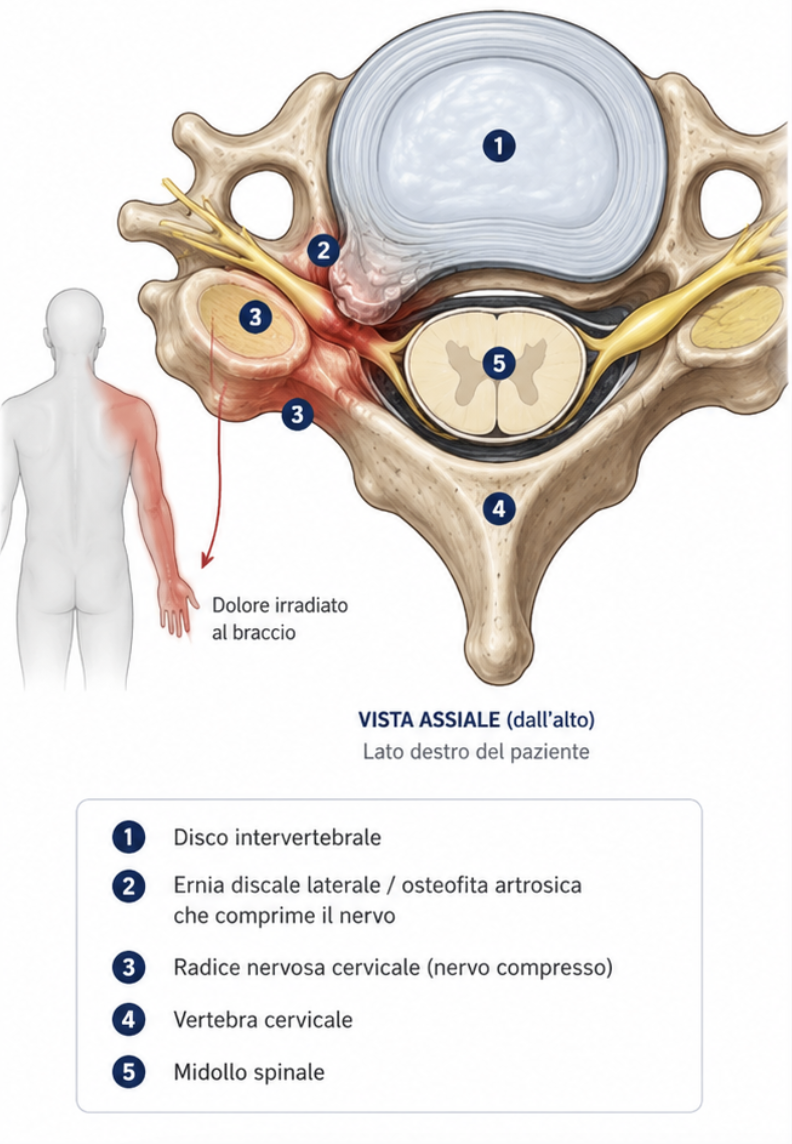
Illustration showing a cervical foraminal stenosis
Our minimally invasive technique
In our center, posterior cervical foraminotomy is performed using a minimally invasive percutaneous microsurgical technique.
The procedure is performed under general anesthesia, with the patient lying prone. Using intraoperative O-Arm CT imaging and neuronavigation, the exact level to be treated can be identified, allowing the tubular retractor to be positioned directly in front of the compressed nerve.
The skin incision is usually approximately 2–3 cm and is made on the posterior aspect of the neck, on the side of the compressed nerve. Through a transmuscular approach, a tubular retractor of approximately 14–16 mm is inserted. Under microscopic visualization, a small bony window is created and, if necessary, the arthritic tissue or disc herniation compressing the nerve is removed.
The goal of the procedure is to achieve targeted decompression of the nerve root while preserving the surrounding anatomical structures as much as possible.
Advantages of the posterior approach
The main advantage of posterior cervical foraminotomy is that it allows the nerve to be decompressed without removing the disc and without fusing the cervical segment.
This means that, in selected cases, cervical fusion can be avoided and the natural mobility of the operated level can be preserved. In addition, the minimally invasive approach reduces muscle trauma, limits the size of the incision and may support a faster recovery.
This technique is particularly useful when the compression is lateral, meaning located within the foramen, and when there is no significant disc degeneration or cervical instability requiring stabilization.
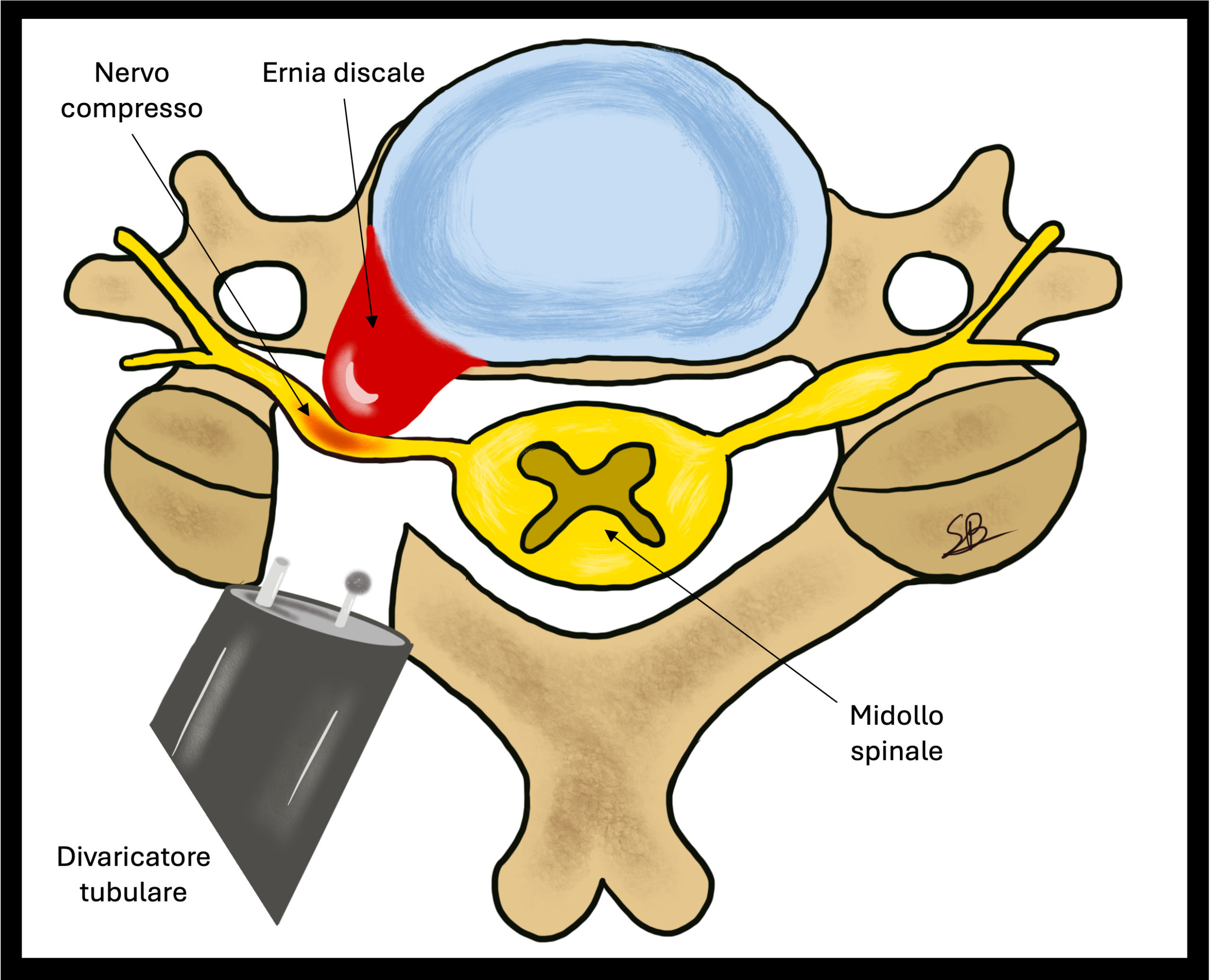
Illustration showing the posterior approach for a foraminotomy
After the procedure
After surgery, patients can usually get up and walk on the evening of the operation. Postoperative pain is managed with appropriate medication.
Discharge from the clinic usually takes place after approximately two days. Follow-up visits are then scheduled to assess wound healing, pain evolution and neurological recovery.
Return to daily activities is progressive and adapted to the individual clinical situation of each patient.
Risks of the procedure
As with any surgical procedure, posterior cervical foraminotomy carries certain risks. Complications are rare but may include bleeding, infection, wound healing problems, cerebrospinal fluid leakage, residual pain, recurrence of nerve compression or temporary or permanent neurological deficits.
Before surgery, every patient receives detailed information regarding the indication, treatment alternatives and specific risks of the procedure.
In summary
Posterior cervical foraminotomy is a minimally invasive technique used to treat lateral compression of a cervical nerve without fusing the spine. In properly selected patients, it represents an effective option to reduce radicular arm pain while preserving motion at the cervical segment.
If you require an evaluation for a cervical problem and wish to have it performed with us, you may contact us via the online form or by email : segretariato@neurochirurgia-robert.ch