Minimally invasive lumbar decompression and stabilisation (TLIF)
Relieving Nerve Compression and Restoring Spinal Stability
A TLIF (Transforaminal Lumbar Interbody Fusion) is a surgical procedure that combines decompression of the neural structures with stabilisation and fusion of a spinal segment.
This technique may be recommended when lumbar spinal canal stenosis or nerve root compression is associated with spinal instability, vertebral slippage, advanced disc degeneration or spinal deformity.
The procedure has two main objectives:
- To relieve compression of the nerves, thereby reducing radiating leg pain and improving walking ability;
- To stabilise the spinal segment responsible for pain and instability.
The decision to combine decompression with stabilisation is based on the patient’s symptoms, clinical examination and radiological investigations, which may include magnetic resonance imaging, computed tomography and dynamic X-rays.
Our Technique: Neuronavigated Minimally Invasive Trans-Tubular TLIF
Unlike the conventional open approach, which requires extensive detachment of the paraspinal muscles from the spine, Dr Thomas Robert and Dr Sara Bonasia systematically favour a minimally invasive trans-tubular technique.
Through a small paramedian incision, the muscles are not detached from the spine but are gently and progressively dilated. A tubular retractor then provides direct access to the affected spinal segment, allowing the procedure to be performed with the assistance of the operating microscope.
To the best of our knowledge, our team is the only one in Switzerland to systematically favour this minimally invasive trans-tubular approach over the conventional open technique for decompression and TLIF stabilisation procedures.
This strategy helps reduce trauma to the paraspinal muscles and better preserves the posterior structures of the spine.
The entire procedure is performed with the assistance of intraoperative CT imaging and neuronavigation, which makes it possible to minimise the risk of incorrect positioning of the spinal implants.
Main Advantages of the Minimally Invasive Approach
- Smaller skin incisions
- Reduced injury to the paraspinal muscles
- Lower intraoperative blood loss
- Less postoperative pain
- Earlier mobilisation
- Generally faster functional recovery
- Reduced risk of postoperative scarring and muscle atrophy
How the Procedure Is Performed
The operation is performed under general anaesthesia.
-
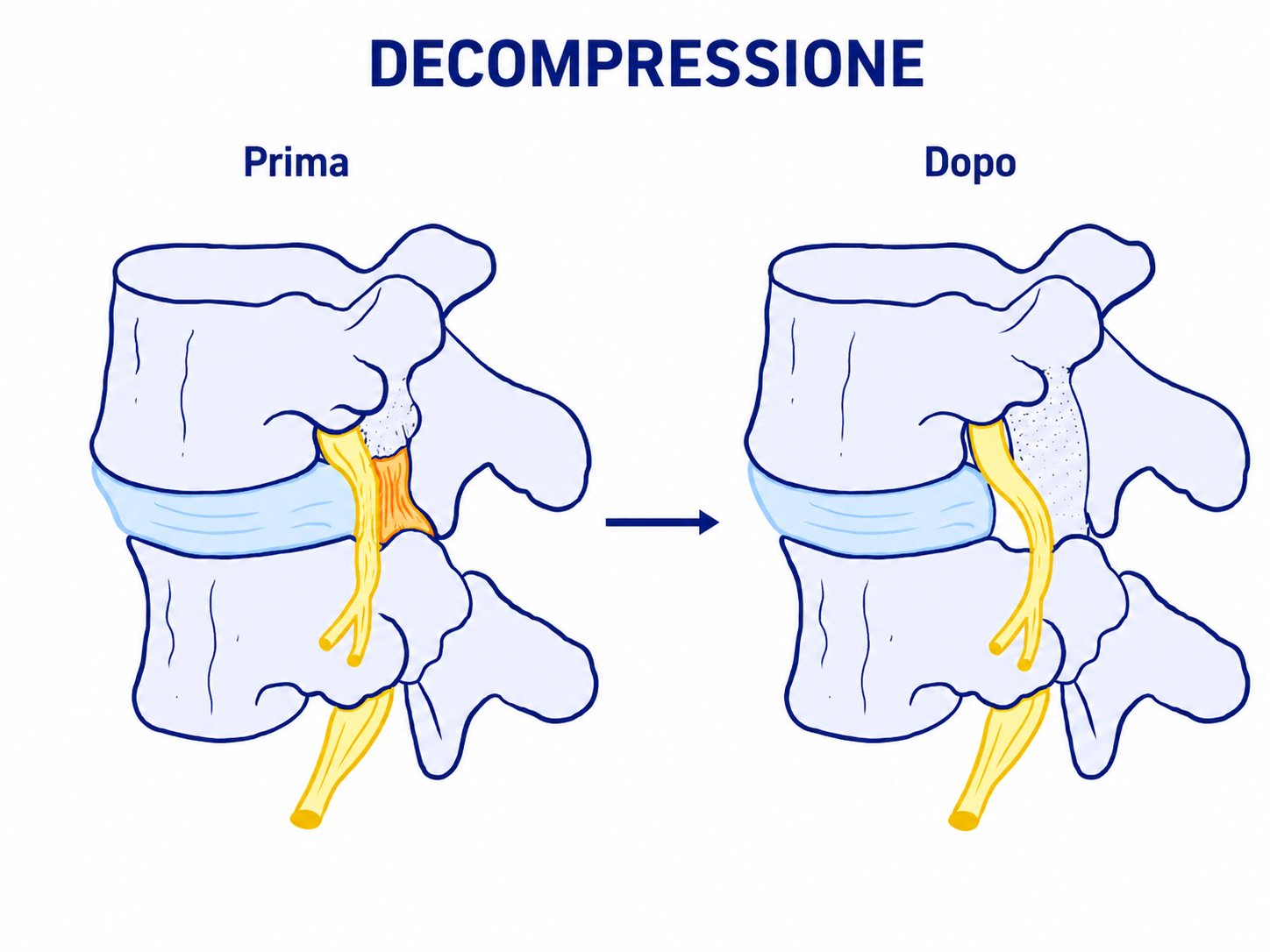
Neural Decompression
Through the tubular retractor and under microscopic visualisation, selected portions of bone, facet joint and thickened ligament responsible for the stenosis are carefully removed. This allows the compressed nerve roots to be fully decompressed.
-
Preparation of the Disc Space
When indicated, the degenerated intervertebral disc is removed through a transforaminal approach, passing laterally to the neural structures.
-
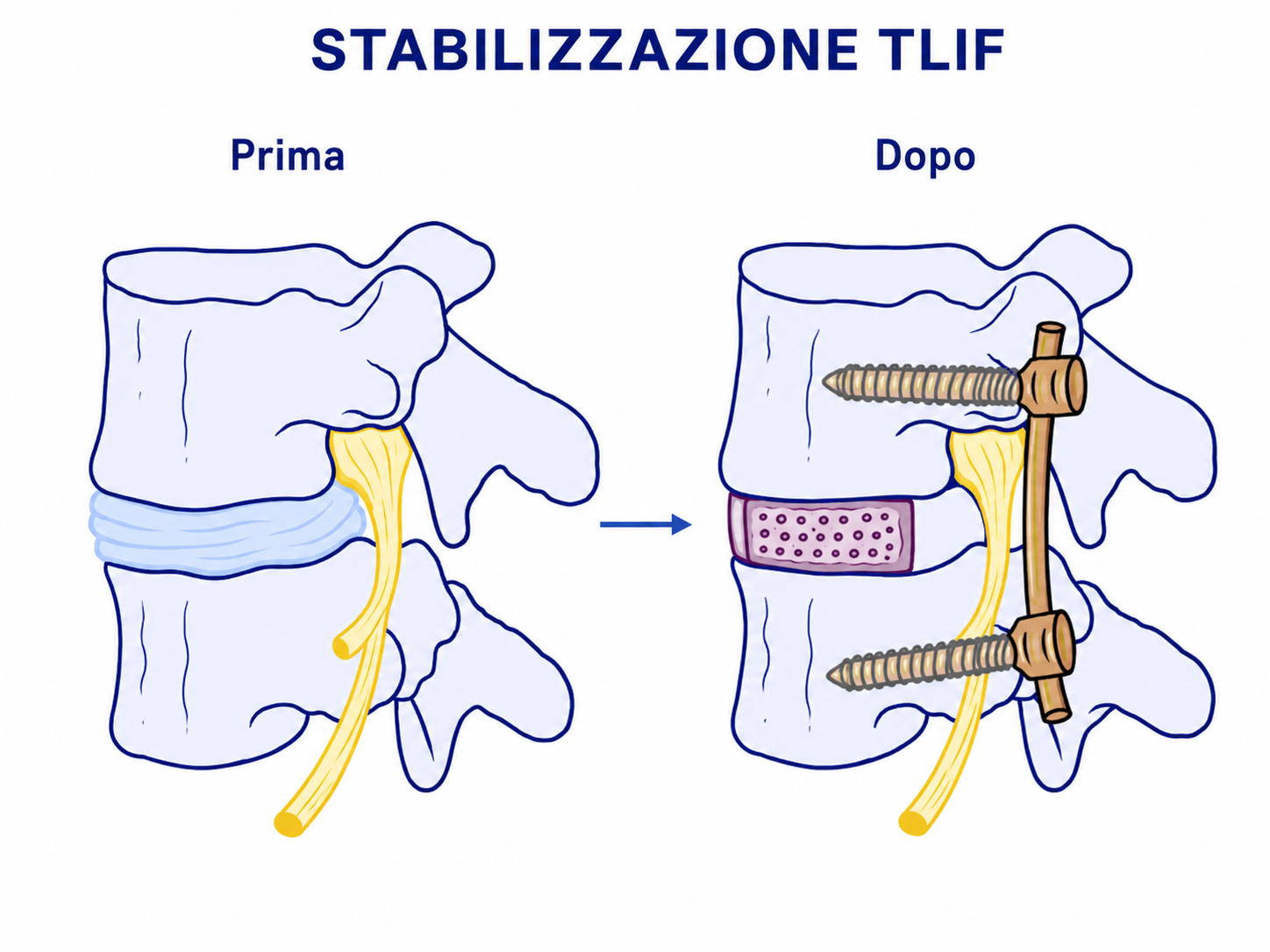
Interbody Fusion
The disc space is carefully prepared, and an interbody spacer, commonly referred to as a cage, is inserted. The cage restores disc height and provides mechanical support to the affected spinal segment.
As standard, we use a new-generation expandable cage in order to reduce the risk of secondary implant migration.
-
Percutaneous Stabilisation
Titanium pedicle screws are inserted and connected with rods. This part of the procedure is also performed using a minimally invasive technique through small skin incisions.
The combination of the cage and the pedicle screw–rod system progressively allows a stable bony fusion to develop between the vertebrae.
When Is a TLIF Indicated?
Decompression combined with TLIF stabilisation may be indicated in the following situations:
- Lumbar spinal stenosis associated with instability
- Degenerative or isthmic spondylolisthesis
- Painful degenerative disc disease
- Foraminal stenosis with loss of disc height
- Instability following previous decompression surgery
- Recurrent disc herniation associated with degeneration and instability
- Pseudarthrosis or degeneration following a previous spinal fusion
Not all cases of lumbar spinal stenosis require stabilisation. When the spine remains stable, a minimally invasive decompression without implants may be sufficient.
The treatment is therefore tailored to each patient, avoiding spinal fusion when there is no genuine biomechanical indication.
Extensive Surgical Experience
Dr Thomas Robert and Dr Sara Bonasia have a combined experience of more than 1,000 decompression and spinal stabilisation procedures for degenerative spinal disorders.
Our practice performs approximately 100 minimally invasive TLIF procedures each year and has particular expertise in minimally invasive spinal surgery.
The high surgical volume, systematic use of the trans-tubular technique and availability of modern technologies allow each procedure to be planned individually, with the aim of achieving complete decompression and precise stabilisation while minimising surgical trauma.
What Are the Risks of the Procedure?
As with any surgical procedure, decompression and TLIF stabilisation involve certain risks.
In experienced hands, the overall risk of major complications is generally around 2–3%, although the individual risk varies depending on age, general health, the number of spinal levels treated and any previous operations.
Possible complications include:
- Infection, bleeding, thrombosis or delayed wound healing
- Dural tear with leakage of cerebrospinal fluid
- Irritation or injury of a nerve root, with sensory or motor deficits and, very rarely, bladder or bowel dysfunction
- Malposition, loosening, migration or breakage of the implants
- Failure of bony fusion, known as pseudarthrosis, sometimes requiring further surgery
- Persistent or recurrent pain despite technically adequate decompression
- Degeneration of adjacent spinal segments over the years
The surgeon’s experience, careful preoperative planning and systematic use of minimally invasive, microscopic and trans-tubular techniques contribute to reducing these risks, although they cannot be completely eliminated.
After the Procedure
Patients are generally mobilised early, often on the day of surgery or on the first postoperative day.
The length of hospital stay depends on the number of treated levels, the patient’s age and general health. The average postoperative stay is approximately two days.
During the following weeks, a gradual return to normal daily activities is recommended, together with an individually tailored physiotherapy programme.
Radicular pain often improves rapidly. Recovery of sensation, muscle strength and walking ability may, however, continue for several months, particularly when nerve compression has been present for a long time.
Bony fusion is a progressive process that develops over the first twelve months and is monitored through clinical follow-up and radiological examinations.
A Personalised Solution, Not a Standard Procedure for Everyone
TLIF is an effective procedure, but it should only be recommended when there is a genuine indication for spinal stabilisation.
During the specialist assessment, we carefully evaluate:
- The origin of the symptoms
- The degree of neural compression
- The presence of spinal instability
- Bone quality
- The sagittal and coronal balance of the spine
- Any previous surgical procedures
- The patient’s general health and expectations
The objective is not simply to insert implants, but to select the least invasive procedure capable of treating the underlying problem effectively.
Would You Like a Specialist Opinion?
We offer a personalised neurosurgical assessment, including a detailed review of symptoms and radiological imaging.
This allows us to determine whether a minimally invasive decompression alone is sufficient or whether decompression combined with minimally invasive TLIF stabilisation is indicated.
If you need a specialist evaluation and wish to have it performed with us, you may contact us via the online form or by email : segretariato@neurochirurgia-robert.ch